
Audio Visual
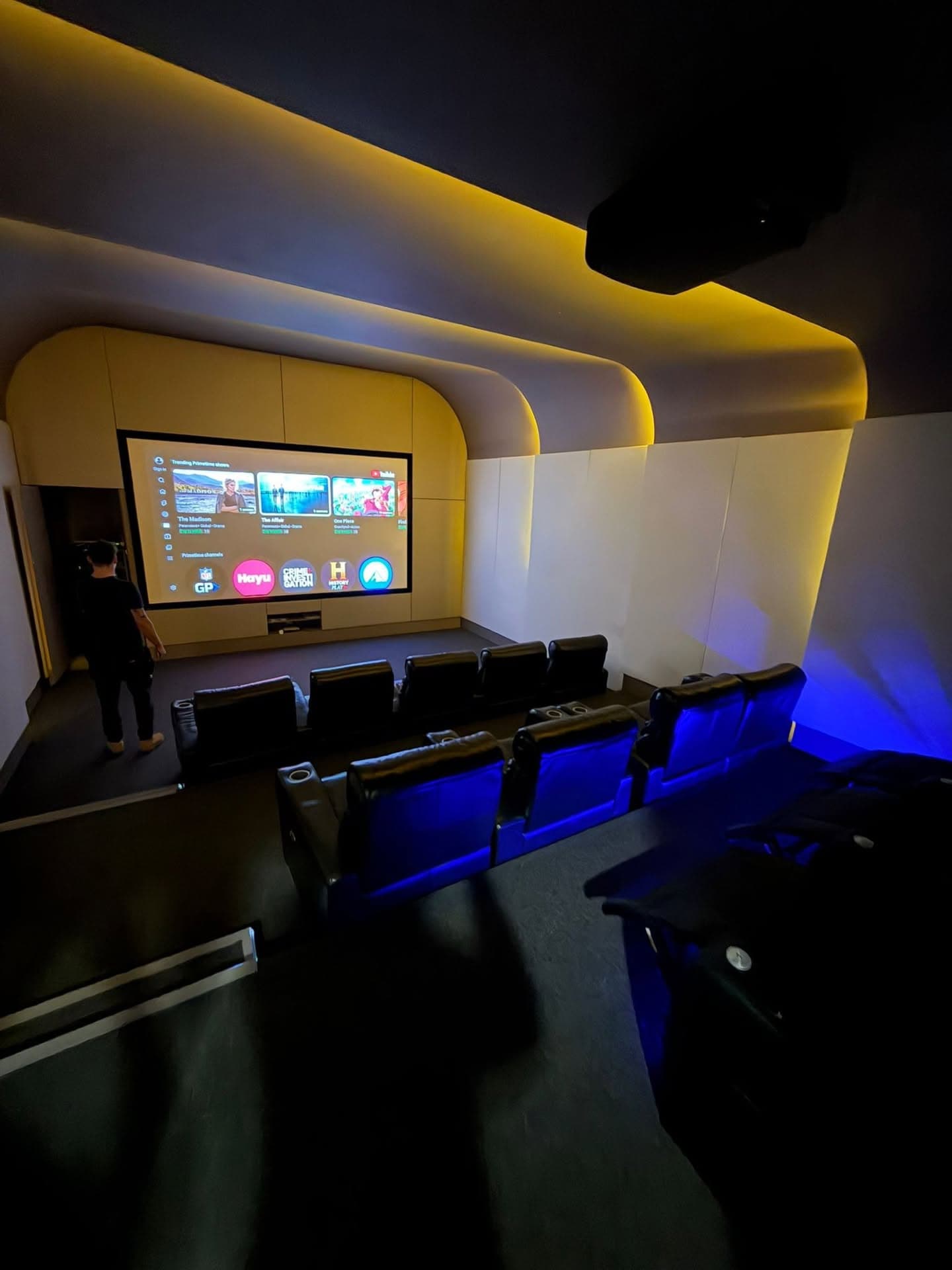
Home cinema installation in Kent
Dedicated cinema rooms and living-room systems, designed around the room you actually have rather than around the equipment somebody wants to sell you.



- Free estimates
- Insurance work undertaken
- Domestic & commercial
The room decides the system, not the other way round
Almost every disappointing home cinema was specified backwards: the screen and the amplifier were chosen first and the room was expected to cope. It does not work that way. Seating distance, room shape, how the space is lit and where you can physically put speakers set the ceiling on what any equipment can do.
So the first questions are dull and they matter more than the brochure. How far will people actually sit from the screen. Can the room be darkened, or does it have to work in daylight. Is there anywhere to put a projector that is not directly above somebody's head. Where can a subwoofer go without shaking a bedroom above.
Screen size is a calculation, not a preference
There are published standards for this and they are worth knowing before anybody quotes you. THX recommends a viewing angle of 36 degrees as the minimum for a cinematic experience, with 40 degrees as the ideal. SMPTE is more conservative at 30 degrees. In practice that means a primary seat somewhere between 1.0 and 1.6 times the screen diagonal away from it.
To make that concrete: at a ten foot seating distance, the THX figure lands around a 120 inch screen and the SMPTE figure around 100 inches. Bigger is not automatically better. Sit too close to too large a screen and you stop being able to take in the whole picture, which is tiring rather than immersive.
For projection there is a second calculation, the throw ratio, which is simply the distance from the screen divided by the image width. A projector with a throw ratio of 1.5 needs to sit 1.5 feet back for every foot of screen width. That number decides whether the projector you like can physically go where the room allows, and it is worth checking before ordering rather than after.
Sound, and the part people underestimate
Most rooms do more damage to sound than most equipment can fix. A room with hard floors, large glass and parallel walls will make a good system sound harsh and indistinct, and no amount of extra speakers corrects it.
The usual guidance is to treat somewhere between 20 and 30 per cent of the wall surface. That is the range that kills the echo without going too far the other way and leaving the room sounding dead and airless, which is a real and unpleasant failure mode. Soft furnishing, curtains and a rug do a surprising amount of that work in an ordinary living room, so a dedicated cinema room and a family living room need very different approaches.
What we install
From a single well-set-up room to a dedicated cinema, including the parts that are not the equipment.
- Projector and screen installation, including ceiling mounting and throw calculation
- Large-format TV installation where projection does not suit the room
- Surround sound, including in-ceiling and in-wall speakers where a room cannot take boxes
- Cabling and containment, run before decorating rather than chased in afterwards
- Source equipment, racking and ventilation, because equipment cupboards get hot
- Control and single-remote operation, so the system is usable by everyone in the house
- Outdoor and garden cinema setups
Plan the cabling before the plastering
The single cheapest thing you can do is decide early. Cable is trivial to run in a room that is already stripped and enormously disruptive to run in a finished one. If a room is being refurbished, extended or built, that is the moment to put in more than you think you need.
It costs very little extra at first-fix to run a spare cable to the screen position and the speaker locations. It costs a great deal to add one later, and that single decision is the difference between a system that can be upgraded and one that is stuck as it is.
Common questions
Frequently asked questions
How big should my screen be?
It follows from where you will sit. THX puts the minimum cinematic viewing angle at 36 degrees and the ideal at 40, and SMPTE is more conservative at 30, which in practice means sitting between about 1.0 and 1.6 times the screen diagonal away. At a ten foot seating distance that is roughly 100 to 120 inches. We measure the room and work from that rather than starting with a screen you liked in a showroom.
Do I need a dedicated room?
No, and most of the systems we fit are not in one. A dedicated room lets you control light and acoustics completely, which is why the results are better. A living room can be excellent with the right screen for the light levels, sensible speaker positions and cabling done properly. What matters is being honest at the design stage about which one you are building.
Projector or a large TV?
Light decides it more than budget. A projector gives you a far larger image for the money and needs the room to be darkenable to look its best. A large TV holds up in daylight and needs no throw distance. If the room has big windows and will be used in the afternoon, a TV is usually the honest recommendation even though it is the smaller picture.
Can you install in a room that is already finished?
Yes, and it is most of what we do. It is more work than first-fix because cable routes have to be found rather than created, and occasionally a run genuinely is not possible without disruption you would not accept. We will tell you which case yours is at the survey rather than discovering it mid-install.
Do you cover home cinema across Kent?
Yes, from Aylesford across Maidstone, Medway, Canterbury, Tunbridge Wells, Sevenoaks and into the wider South East and London. AV work travels slightly further than the security side because it needs less going back to, but we will still tell you honestly if you are beyond where we could return to sort something out.
Free estimates
Want a free estimate in Kent?
No up-selling, just simple honest advice. Domestic and commercial work across Aylesford, Maidstone, Medway, Sittingbourne, Gravesend, Canterbury, Tunbridge Wells, Sevenoaks, Dartford, Bromley.