
Security Systems
Commercial security systems in Kent
One team for the whole of a commercial site: alarms, cameras, access control, fire detection and gates, surveyed together rather than bought from four suppliers.
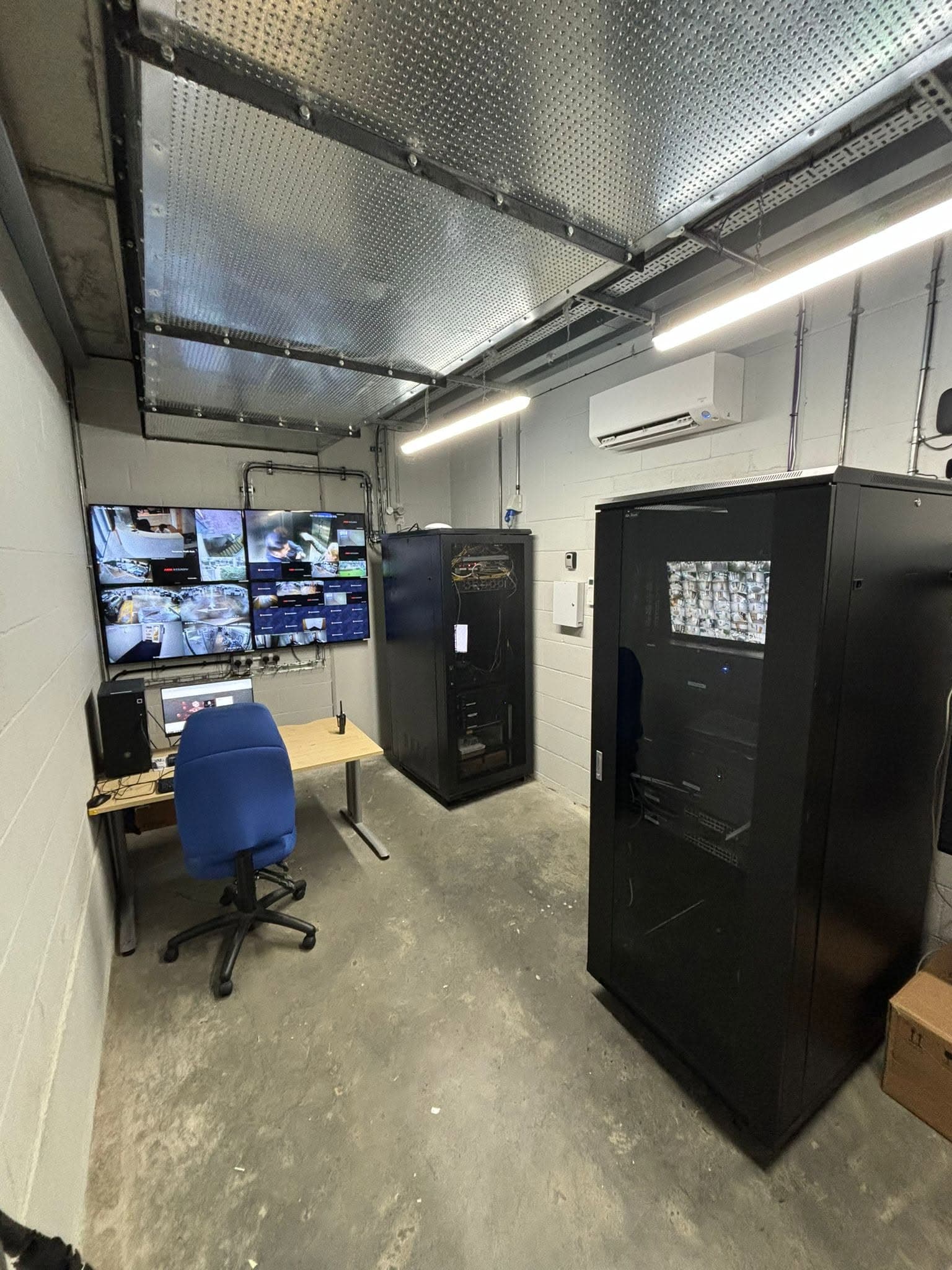


- Free estimates
- Insurance work undertaken
- Domestic & commercial
Commercial is a different exercise to domestic
The equipment overlaps. Almost nothing else does. A house has a handful of approaches and one household. A commercial site has staff, deliveries, vehicles, stock, public access and, usually, somebody who needs to know what happened without being on site.
The consequences differ too. A gap in domestic coverage is an annoyance. On a commercial site it can mean an insurance claim you cannot substantiate, a health and safety incident with no record, or a supplier dispute where the delivery either arrived or it did not. Those are the questions the system exists to answer, and they should decide the design before anyone discusses cameras.
What a commercial site usually needs
Rarely everything at once. Most sites are best done in a sensible order, starting with whatever currently keeps you awake.
- Intruder alarms zoned so parts of a building can be set while others are in use
- CCTV covering entrances, loading areas, yards and vehicle movements
- Access control, so leavers lose access without changing every lock
- Door entry and intercom on the main entrance
- Fire detection specified to the category your risk assessment names
- Electric gates and barriers on vehicle entrances
- Maintenance, which on commercial premises is usually an insurance condition
The duties that come with it
Operating CCTV as a business makes you a data controller, which is a heavier obligation than a householder carries. It means signage saying recording takes place and who operates the system, a retention period you can justify rather than whatever the recorder defaulted to, and a route for somebody to request footage of themselves.
Cameras covering staff working areas need particular thought. Recording a shop floor that staff happen to work on is ordinary. Pointing a camera at one workstation to watch an individual is a different thing and needs a reason you would be comfortable explaining. We raise it at survey rather than fitting what is asked for and leaving you to discover it later.
On fire, the duty sits under the Regulatory Reform (Fire Safety) Order 2005 and falls on the responsible person. The alarm specification comes out of your fire risk assessment, so any quote that names a category without asking what your assessment says is starting in the wrong place.
One supplier, one set of cabling
The practical argument for doing this together is not a discount. It is that the alarm, the cameras, the access control and the gate all want power and network in the same places, and the disruptive part of the work is getting cable through a building.
Doing it as one exercise means one set of containment, one mobilisation and one company to ring. Doing it as four means paying repeatedly for the same access work and then trying to make four systems cooperate afterwards.
Common questions
Frequently asked questions
Can you do everything, or do we need separate contractors?
Everything on this list, which is the main practical reason to use one firm. Alarms, CCTV, access control, door entry, fire detection and gates are all surveyed together, so the cabling and the access work happen once. Where a job genuinely needs a specialist we do not employ, we will say so rather than take it on.
Do you work around our opening hours?
Yes, where the work would otherwise disrupt trading. Our normal hours are Monday to Saturday, 9 to 5, and we schedule around a business where it is needed. Worth raising at survey rather than after the quote, because it affects how the job is sequenced and priced.
How often does a commercial system need servicing?
It depends on the system and on what your insurer requires. Intruder alarms are typically once a year, or twice where the system is monitored or higher risk. Commercial fire systems are approximately six monthly with a permitted five to seven month window. CCTV on a larger site is usually better on twice a year. Where a policy names a frequency, that is the answer.
Will this satisfy our insurers?
It can, and the way to be sure is to work from what the policy actually says rather than assuming. If your insurer names an alarm grade or a maintenance regime, tell us and we will specify to it. Where nothing is named we will tell you what would ordinarily be expected for the risk, and it is worth confirming with the insurer before the work rather than at claim time.
Do you take over systems already on site?
Yes, and on commercial premises it is common when a building changes hands or a managing agent changes. The usual obstacle is administrative rather than technical, meaning nobody has the engineer codes or the recorder credentials. That is often recoverable. Bring whatever documentation exists and we will tell you where you stand before quoting.
Free estimates
Want a free estimate in Kent?
No up-selling, just simple honest advice. Domestic and commercial work across Aylesford, Maidstone, Medway, Sittingbourne, Gravesend, Canterbury, Tunbridge Wells, Sevenoaks, Dartford, Bromley.