
Security Systems
Car park barriers and parking management in Kent
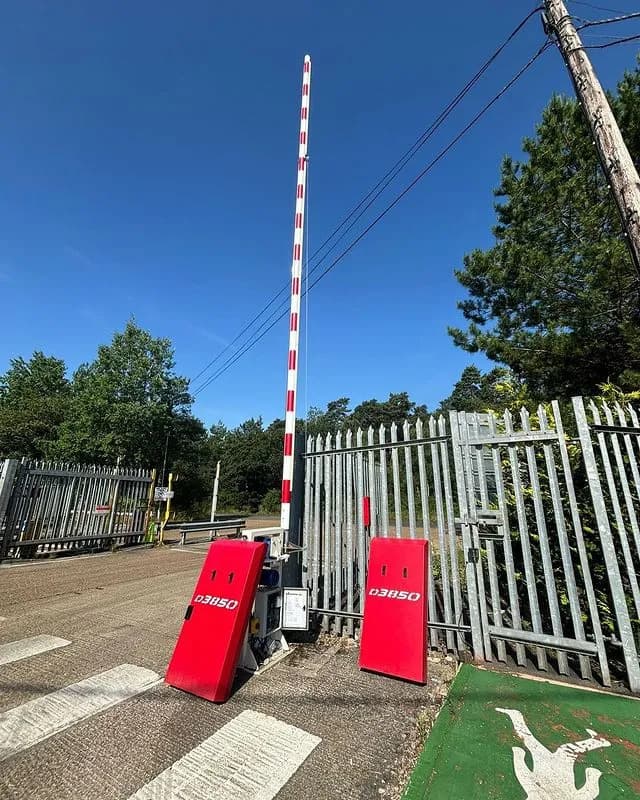
Automatic rising arm barriers for car parks, business parks, blocks of flats and yards across Kent, with the entry system, vehicle detection and safety devices designed in from the start rather than added afterwards.



- Free estimates
- Insurance work undertaken
- Domestic & commercial
What a car park barrier system is made of
The arm is the part everyone sees, and it is the least interesting part of the job. A barrier that works well for years is a small system, and most of the problems people have with barriers come from one of the other pieces being chosen badly or left out.
Whether you are controlling a staff car park, the parking under a block of flats or the way into a yard, the same pieces come up every time.
- The barrier itself, a motor cabinet and a boom arm sized to the width of the lane
- The way drivers are let in, from a fob reader or keypad to an intercom, a long range tag or an ANPR camera
- Vehicle detection loops cut into the road surface, which tell the barrier a car is there
- Safety devices, so the arm will not come down on a car or a person underneath it
- Free exit, so drivers leaving simply drive up and the barrier lifts
- Power, ducting and a network link back to the building, which is usually where the groundwork goes
Choosing how drivers get in
This is the decision that shapes the rest. Fobs and cards are cheap, quick to read and easy to cancel when somebody leaves, but they have to be handed out and they get lent to friends. Keypad codes cost nothing to issue and are passed round just as freely, so a code that never changes stops meaning much within a year.
Long range tags sit on the windscreen and are read as the car approaches, which suits a fleet or staff who come and go all day. ANPR reads the number plate against a list of known vehicles, so there is nothing to hand out at all, but it needs a camera chosen and placed for plates and it brings data protection duties with it, which our ANPR page explains.
Most car parks end up with two methods side by side, one for the people who use it every day and an intercom for everybody else. Visitors, deliveries and taxis press a button and speak to reception or to a phone, and the barrier is opened from there. We fit that as part of the same job, and our access control and door entry page covers the intercom side in more detail.
Loops, and how the barrier knows a car is there
A vehicle loop is a coil of cable laid in a slot cut into the road surface. When a car stops over it, the metal in the car changes the loop's signal and a detector in the barrier cabinet registers a vehicle. Loops do three different jobs, and a well designed entrance usually has more than one.
A safety loop sits under the arm and holds the barrier up while a vehicle is over it, so the arm cannot drop onto a car that has stopped halfway through. An exit loop on the way out lifts the barrier for anyone leaving, with no reader needed. An arming loop on the way in can be set so the reader only works when a vehicle is actually there, which stops people opening the barrier on foot.
Because loops live in the road surface, resurfacing, a new drainage run or a heavy vehicle breaking the edge of the slot can all cut them, and a cut loop is one of the most common barrier faults. Smaller vehicles such as motorbikes are also harder for a loop to see, so if bikes use the entrance that needs deciding at design rather than discovering afterwards.
A barrier is machinery, and people on foot are the risk
A powered barrier at a workplace falls under the Workplace (Health, Safety and Welfare) Regulations 1992. Regulation 18 says any powered door or gate must have suitable and effective features to stop it injuring anyone by trapping them, regulation 5 says it must be maintained, and the industry reads both as covering barriers. The duty sits with whoever controls the site, which is often a business, a landlord or a managing agent rather than the person who fitted it.
The industry code of practice from the DHF, the trade body for doors and gates, sets out how that is met on a barrier. Force limitation on its own is not enough wherever the arm closes automatically and members of the public can reach it, so a photocell beam is fitted either directly under the line of the arm or one on each side. On a barrier with a skirt hanging below the arm, the closing gaps in the skirt need protecting too.
The thing that actually hurts people is someone walking under the arm, so the entrance needs a separate, marked footpath beside the barrier for anyone on foot, ideally fenced off from the lane. The code is clear that a pedestrian route does not remove the need for the safety devices on the barrier, it sits alongside them. Our security fencing work often covers that short run of railing at the same time.
Planning the entrance before choosing the barrier
Where the barrier goes matters as much as which barrier it is. It needs to sit far enough back from the road that a car waiting for it to lift is standing off the highway and the pavement, not blocking traffic behind it. On a busy road that usually means room for at least one full car length, and highway authorities commonly look for around five metres.
Think about the busiest ten minutes of the day as well as the average. A staff car park where most people arrive between half past eight and nine can queue back onto the road if the barrier is slow or the reader is awkward to reach from the driving seat. A driver who is refused entry needs somewhere to turn round other than reversing out into traffic.
Then there is what happens when things go wrong. Decide whether the barrier should stay up or stay down in a power cut, make sure there is a manual release and that the people on site know where it is, and agree how fire engines and ambulances get in. On a block of flats or a shared business park, agree with the managing agent who controls the list of users, because a barrier nobody can update quickly becomes a barrier everybody props open.
Parking management without the parking tickets
We install and maintain the equipment that controls who gets into a car park. We are not a parking enforcement company and we do not issue parking charges. That distinction is worth knowing before you start, because the two solve different problems. A barrier stops cars getting in that should not be there. Enforcement lets anyone in and charges the ones who should not have parked afterwards.
If enforcement is what you want, that is a job for a parking operator. To get a vehicle keeper's details from the DVLA, an operator has to belong to one of the two accredited trade associations, the British Parking Association or the International Parking Community, and follow the private parking sector's single code of practice. For most private car parks used by staff or residents, a barrier deals with the problem at the entrance and there is nothing left to enforce.
Where you want a record of what came and went, cameras do that job. ANPR logs every plate at the barrier, and ordinary commercial CCTV covering the entrance shows what happened if an arm is hit or a car tailgates through. Both record personal data, and the ICO expects a data protection impact assessment for ANPR, clear signs that it is in use, as few cameras as the purpose needs and a set time for deleting the records.
Barrier, gate or both
A barrier controls traffic, it does not secure a site. Anyone on foot can step round it and a determined driver can go through it. If the car park needs closing completely at night, that is a job for a gate or a fence line, and our electric gates page covers the choice between swing and sliding gates.
Plenty of sites use both, a barrier for the working day when traffic is constant and a gate that closes the entrance out of hours. Done together, they can share the same loops, readers and intercom, so drivers use one system rather than two. For a wider look at a commercial site, our commercial security page covers how barriers fit alongside alarms, cameras and access control.
Servicing and repairs, including barriers we did not fit
Barriers work hard. A busy entrance can lift the arm hundreds of times a day, outdoors, all year. The usual faults are wear and weather rather than anything dramatic. Arms get hit by vehicles, loops are cut by roadworks, photocells get knocked out of line or dirty, water gets into the cabinet and controllers fail after a storm.
Regular servicing is part of the legal duty as well as good sense. The DHF code says the maintenance frequency should come from the manufacturer's instructions and that the owner should have a log book recording each visit. We will service barriers that somebody else installed, and where safety devices have been disconnected or never fitted we will say so plainly and tell you what putting it right involves.
We are based in Aylesford, so Maidstone, Medway and the towns along the M20 and M2 are close, and we cover the rest of Kent, the South East and south east London. If you are not sure where to start, a security survey looks at the entrance alongside everything else on the site.
Common questions
Frequently asked questions
How much does a car park barrier cost?
It depends on the width of the lane and so the length of the arm, how many lanes there are, how drivers will be let in, and how much groundwork the loops, ducts and power need. Getting a supply and cabling to the barrier is often a bigger part of the cost than the barrier itself. We survey the entrance and then quote, and the estimate is free.
Can the barrier open automatically for our own vehicles?
Yes. Long range windscreen tags or ANPR both let known vehicles in without anyone reaching for a fob. Tags are read as the car approaches and suit a staff fleet. ANPR reads the plate against a list, so there is nothing to hand out, but it needs a camera placed for plates and it brings data protection duties, including signage and a set time for keeping the records.
What happens to the barrier in a power cut?
That is a decision to make at the start. Some sites want the barrier to lift and stay up so nobody is trapped inside, others want it to stay down. Either way there should be a manual release that the people on site know how to use, and battery backup is available on many barriers where the entrance cannot be left without power.
How do visitors and deliveries get through?
Usually through an intercom at the barrier. The driver presses a button, speaks to reception or to a phone, and the barrier is opened from there. A video intercom lets whoever answers see the vehicle as well. It sits alongside whatever regular users have, so staff use their fob or tag and everybody else uses the intercom.
Do you issue parking charges or run parking enforcement?
No. We install and maintain the barriers, readers, cameras and intercoms that control who gets in. Issuing parking charges is the work of a parking operator, who needs to be a member of the British Parking Association or the International Parking Community to get keeper details from the DVLA. For most private car parks, a barrier stops the problem at the entrance instead.
Do you repair barriers that another company installed?
Yes. Arms that have been hit, loops cut by roadworks, faulty photocells and failed controllers are the usual call outs, whoever fitted the barrier. Where safety devices have been bypassed or were never fitted, we will tell you that and what putting it right involves rather than repairing around it.
Free estimates
Want a free estimate in Kent?
No up-selling, just simple honest advice. Domestic and commercial work across Aylesford, Maidstone, Medway, Sittingbourne, Gravesend, Canterbury, Tunbridge Wells, Sevenoaks, Dartford, Bromley.