
Audio Visual
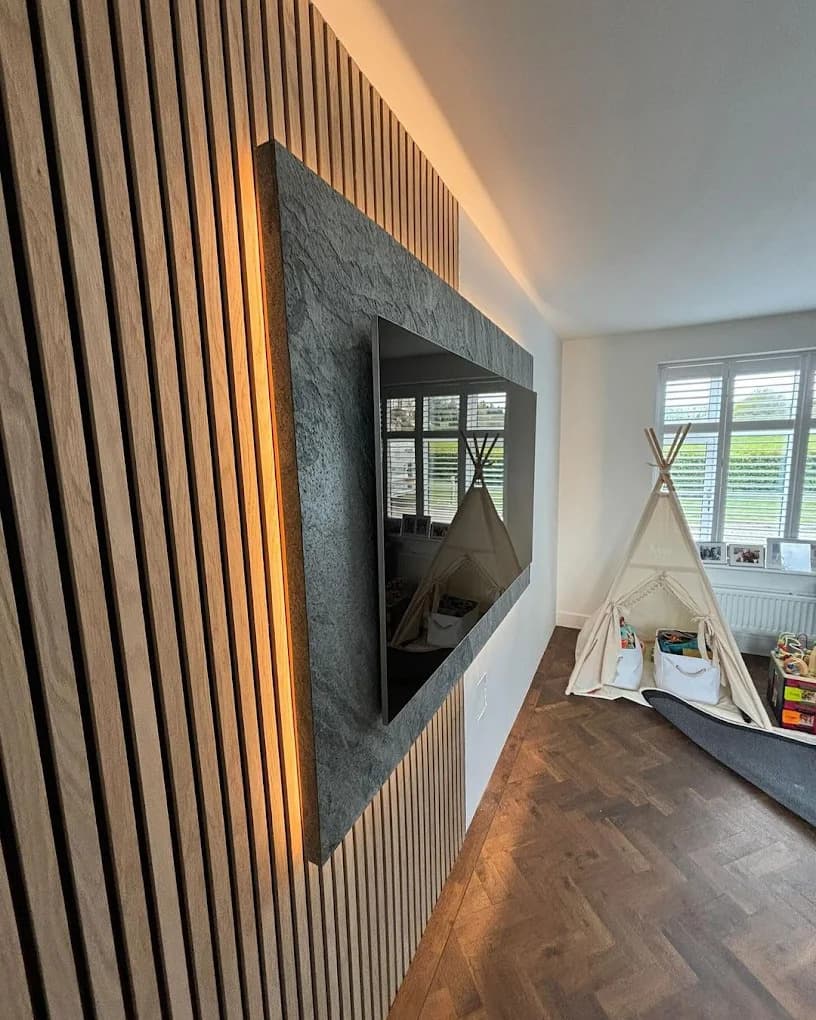
Media walls and TV wall mounting in Kent
Media walls built properly, and televisions mounted into something that will hold them. Including the fire clearance question that a lot of media wall builds get wrong.


- Free estimates
- Insurance work undertaken
- Domestic & commercial
The fire clearance problem, said plainly
A media wall with an electric fire below a television is the most popular thing in this trade at the moment, and it is the one most often built without checking the one number that matters. Electric fires throw heat upwards. A television mounted in that rising heat will run hot, and the usual guidance is that the temperature behind the screen should stay below 40 degrees.
Typical minimum clearances between an electric fire and a screen above it sit somewhere between 300 and 500mm, but that range is not the answer. THE MANUFACTURER'S INSTRUCTIONS ARE THE ANSWER. If the manual for your fire says 400mm, it is 400mm. If it says do not mount a television above this appliance, then you do not, whatever the internet says the average clearance is.
This matters beyond the television. UK product safety rules turn on the appliance being used as the manufacturer specifies, so a fire installed outside its own instructions moves the liability, and any heat damage to a screen is very unlikely to be a warranty claim.
What is actually inside a media wall
Most media walls are a timber or metal stud frame with plasterboard over it, which means the cavity behind that handsome finish contains combustible material and often insulation. That is fine, and it is why the board specification matters.
Fire-rated plasterboard slows heat transfer into the structure and is the sensible choice around a heat source. It is not a substitute for the clearance above, and anybody offering it as one has the reasoning backwards: the board buys you time, the clearance stops the problem starting.
The other thing the cavity needs is ventilation and access. Equipment gets hot, and a recess with no airflow will shorten the life of whatever is in it. An access route to the cabling is what makes the wall serviceable rather than something that has to be opened up the first time a device is replaced.
Fixing a television to a wall that will hold it
A large television on a cantilevered bracket applies far more leverage than its weight suggests, and the failure mode is not gentle. So the bracket goes into structure: studs, noggins put in specifically for the job, or masonry with the correct fixings for that masonry.
Plasterboard alone will not do it, whatever the fixings claim. On a chimney breast the construction is often not what it looks like, and older properties in Kent throw up plenty of walls where the outer skin and the structure behind it are different materials entirely. That is a thing to establish before drilling.
What we do
Design, build and finish, or just the mounting and cabling if the joinery is somebody else's.
- Media wall design and build, including recesses sized to the equipment
- Correct clearance planning around electric fires, to the appliance's own instructions
- TV wall mounting on plasterboard stud, masonry and chimney breasts
- Fully concealed cabling, power and HDMI brought out behind the screen
- Soundbar and speaker integration into the wall
- Equipment recesses with ventilation and future access
- Making good, so the wall looks finished rather than worked on
Common questions
Frequently asked questions
Can I put a TV above an electric fire?
Usually yes, and the clearance comes from the fire's own manual rather than from a rule of thumb. Typical minimums sit between 300 and 500mm, but some appliances state a specific figure and a few say not to mount a television above them at all. That instruction is the answer for that model. We check it before designing the wall, because the recess height is decided by it.
Will the heat damage my television?
It can, and it is the most common thing that goes wrong on a badly planned media wall. The guidance is to keep the temperature behind the screen below about 40 degrees. Get the clearance right and it is a non-issue; get it wrong and you get a screen running permanently warm, a shortened life and a warranty claim you will probably lose because the installation was outside the fire's specification.
Do media walls need fire-rated plasterboard?
Around a heat source it is the sensible specification, because the cavity behind contains timber and often insulation, and fire-rated board slows heat getting into it. What it is not is a substitute for correct clearance. The board buys time if something goes wrong; the clearance is what stops it going wrong. Anyone offering the board as a reason to reduce the gap has it backwards.
Can you mount a TV on a plasterboard wall?
Yes, but the bracket has to reach real structure behind it: the studs, or noggins fitted specifically for the job. Plasterboard on its own will not hold a large screen on a cantilever arm, regardless of what the fixings claim. On a chimney breast we establish what the wall is actually made of first, because older Kent property regularly is not what it appears.
Can you hide all the cables?
Yes, and it is most of the job. Power and the signal feed come out behind the screen so nothing is visible, either chased in and made good or run through the void depending on the construction. On a media wall build the containment goes in before the boarding, which is why it is worth deciding what will be in that wall before it is closed up.
Free estimates
Want a free estimate in Kent?
No up-selling, just simple honest advice. Domestic and commercial work across Aylesford, Maidstone, Medway, Sittingbourne, Gravesend, Canterbury, Tunbridge Wells, Sevenoaks, Dartford, Bromley.