
What Is the Best CCTV System for a Small Business?
The best CCTV system for a small business is usually a wired IP camera system with a recorder on site and secure remote viewing on your phone, with each camera placed to answer a specific question. How many cameras you need comes from the entrances, tills, stock areas and yard that need covering rather than the size of the building. The make of camera matters far less than where the cameras go and whether the footage is clear enough to identify somebody.
A business also takes on duties a householder does not, because it becomes responsible for the footage under data protection law, and its insurer may well want to see it after an incident. At Bespoke AVS we install commercial CCTV across Kent, the South East and London using HIKVISION equipment. This guide covers why wired IP systems are the usual answer, where the cameras should go, what makes the picture stand up, remote viewing and access, your legal duties as a business, and keeping the system working.
Why a wired IP system is usually the answer
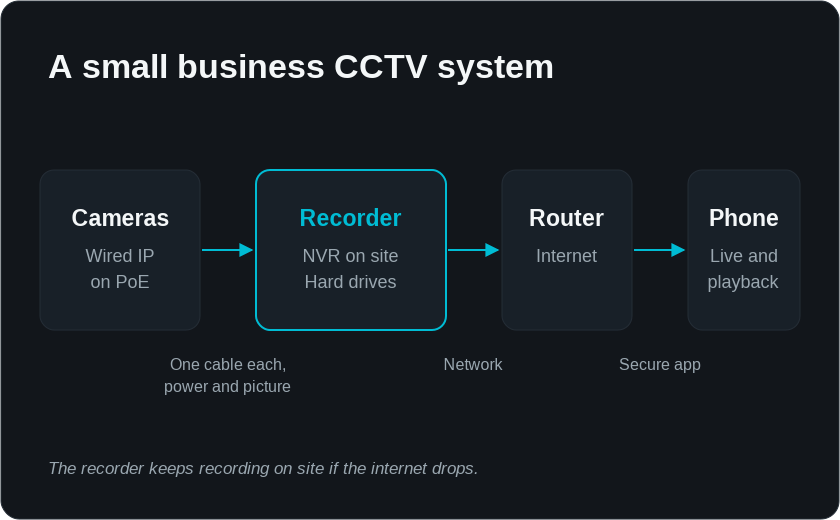
An IP camera is a network camera. It sends a digital picture down a network cable to a recorder, known as an NVR, which stores the footage on hard drives and makes it available on your phone or computer. With Power over Ethernet, one cable carries both the picture and the power to each camera, so there is no separate power supply to run to every position.
A wired IP system is the more dependable choice for a business. A single cable carries power and pictures to each camera, so there is no battery to change and no wireless link to lose at the moment you need the footage. Ofcom's advice on improving your wifi explains why that matters, because wifi signals weaken as they pass through walls and other objects, water, metal and glass block them, other electrical equipment can interfere, and the bandwidth is shared between every device on the network. Wireless cameras still have their place where a cable genuinely cannot reach, such as a detached outbuilding, but as the backbone of a business system they add a weak point you do not need. A recorder on site also keeps recording if the internet goes down, which a system that relies entirely on a cloud connection cannot promise.
Where the cameras should go
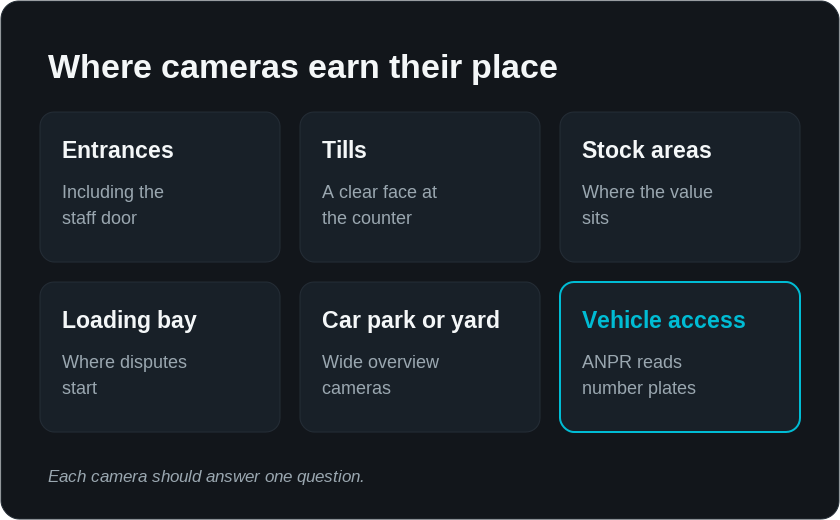
Good commercial CCTV starts with the questions the system has to answer rather than a count of doors. Who came in, and through which entrance. What happened at the till. What left the stockroom. Which vehicle was in the yard when the fence was cut. Each camera should earn its place by answering one of those.
The positions that matter on most small business sites are the entrances, including the staff door and not just the front one, the tills, the stock areas, the loading or delivery point, and the car park or yard. Placement matters more than the number of cameras, because several cameras watching the same patch of yard from slightly different angles add little if the side door goes unrecorded. The police ProtectUK guidance on CCTV starts in the same place, by setting out what information is needed from each camera at each location, and notes that access points can give the best opportunity to identify people and vehicles. Where vehicles come and go through a gate or barrier, ANPR cameras can record number plates and, if you want, open the gate for known vehicles.
Picture quality that stands up
Resolution matters, but only once a camera is pointed at something worth recording and mounted where it captures faces. A camera high on a wall covers a wide area and identifies nobody, so a sensible system mixes wide overview cameras with closer ones at entrances and tills, set to catch a clear face at the point everyone has to pass.
Night is where systems are really tested. On a shopfront or a lit car park, full-colour low-light cameras such as HIKVISION's ColorVu range give colour footage after dark, which makes clothing and vehicles far easier to describe. On an unlit yard or a rural unit there is often too little light for a colour sensor to use, and infrared is the better choice. Knowing the different types of CCTV cameras helps when an installer starts talking about domes, bullets and turrets, but the right answer for each position comes from the survey.
Remote viewing and who can see what
Remote viewing through a phone app is standard on any modern system, and for a small business owner it is often the feature that gets used most, checking the shop after closing or the unit over a weekend. The part that needs thought is access. Decide who can view live footage, who can play back recordings, and who can export them, because an export is a copy of personal data leaving your control. On a multi-site business, a manager can see every site while the staff at each one see only their own, which is set in the recorder's permissions and is far easier to decide before installation than afterwards.
The same network that carries the cameras can also carry access control and door entry, so the door, the gate and the cameras share one set of cabling rather than three.
Your legal duties as a business
A business that records people with CCTV is a data controller, and that brings real duties. The ICO's guide to CCTV for your organisation sets them out. Unless you are exempt, you need to register with the ICO and pay the data protection fee. You need signs telling people they are being recorded and who to contact. You should keep footage only as long as you need it, limit who can see it, and be able to find and hand over someone's footage if they ask for a copy. Audio is rarely justified, and monitoring staff closely, such as watching one person's workstation, is the kind of use that needs a data protection impact assessment and a reason you would be comfortable explaining.
The ICO also publishes a short checklist for limited CCTV systems aimed at small premises such as shops, which is worth working through once the system is in. On retention, how long CCTV cameras store footage comes down to drive size and settings, so set the recorder to a period you can justify rather than whatever it defaulted to.
Keeping it working
A CCTV system fails quietly. The picture still appears and the app still connects right up until the day you need footage and find the drive stopped recording weeks ago, and on a business that can mean an insurance claim you cannot back up. A CCTV maintenance visit checks the recording, the drive health, the camera angles and the night picture, and on a busier site twice a year is usually sensible. If you move into premises that already have cameras, have the system checked before you rely on it and make sure you hold the recorder's admin login, because the footage it records is now your responsibility.
We are Kent County Council Trading Standards Checked and insurance work is undertaken. A security survey is where the camera positions, the recorder and the legal side are settled before anything is ordered, and estimates are free. You can see our recent installations, read what customers say on our reviews page, or find us on Facebook.
Choosing CCTV for a small business
The best CCTV system for a small business is usually wired IP cameras feeding a recorder on site, with secure remote viewing and every camera placed to answer a real question. Get the positions, the night picture and the access permissions right, meet your duties as a data controller, and keep it maintained, and the system will produce footage that stands up when it matters, which is the only reason to have it.
If you are thinking about CCTV for your business, we are glad to survey the site and tell you honestly what it needs. You can get in touch with Bespoke AVS to arrange a survey of your premises and a free estimate, anywhere in Kent, the South East and London.
Keep reading
Related guides
CCTV
Does CCTV Work
Yes, CCTV works, and it is a question we are asked regularly by homeowners and business owners across Kent, London and the South East.
Read guideCCTV
Is CCTV easy to set up?
Many homeowners and business owners consider but often wonder whether the process is complicated.
Read guideFree estimates
Tell us about the job and we'll sort the rest
No up-selling, just simple honest advice. Domestic and commercial work across Aylesford, Maidstone, Medway, Sittingbourne, Gravesend, Canterbury, Tunbridge Wells, Sevenoaks, Dartford, Bromley.