
Can Intruder Alarms Be Hacked?
By Benjamin Williams
Yes, an intruder alarm can in theory be hacked, but in the real world it is far rarer than the headlines suggest, and for almost every home and business it is not where the risk actually lies. A modern, professionally installed alarm uses encryption and tamper detection that make interfering with it genuine hard work, and a burglar who wants in will nearly always take the physical route through a door or window long before they think about radio signals. So the honest answer is that it is possible, it is uncommon, and it is largely avoidable with the right kit set up properly.
The worry almost always comes from wireless and smart alarms, because anything that talks over radio or connects to an app feels like it could be intercepted. At Bespoke AVS we install and maintain intruder alarms across Kent, the South East and London, and we get asked this a lot, usually after a news story about a clever attack in a lab. This guide covers whether it is really possible, the handful of ways it could in theory be done, what stops each of them, how worried you should honestly be, and how to make sure your own system is on the right side of it.
The risks, and what actually stops them
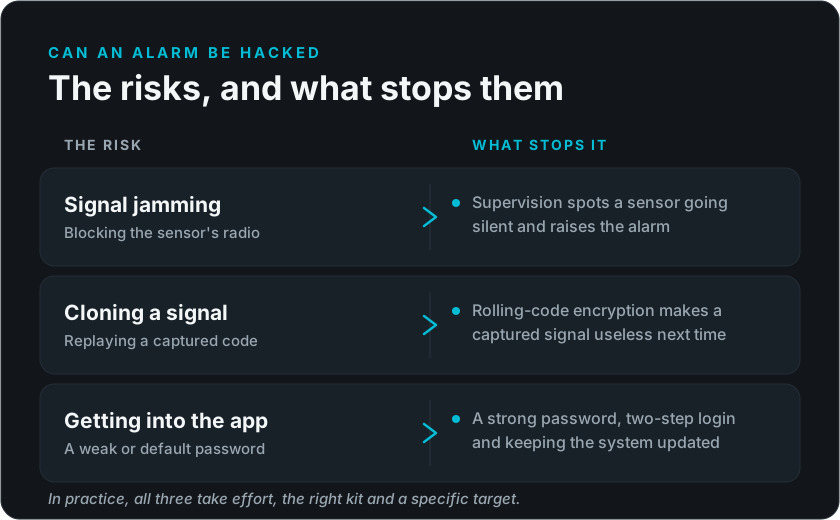
An intruder alarm could, in principle, be interfered with in three ways, and each has a defence that a decent system already has built in. The first is signal jamming, where someone floods the frequency a wireless sensor uses so its messages never reach the panel. The answer to that is supervision, where the panel expects to hear from every sensor on a regular heartbeat and treats silence as a fault or a deliberate attack, so jamming sets off the alarm rather than defeating it.
The second is capturing and replaying a sensor's signal, sometimes called cloning. The defence is rolling-code encryption, where the code changes every time, so a signal grabbed in your driveway is useless the moment it is sent again. The third is not really an attack on the alarm at all, it is getting into the app or account through a weak or default password. That one is on all of us, and it is solved by a strong password, two-step login and keeping the system updated. We fit intruder alarms with all three of these as standard, because leaving them as optional extras is how gaps appear.
How worried should you honestly be
There is a difference between what is possible in a demonstration and what happens on a normal street. Defeating a properly installed alarm electronically takes time, the right equipment and a specific target the attacker has decided is worth the effort. That is a world away from how homes and small businesses actually get broken into, which is almost always the physical way, a forced door or window, an unlocked side gate, or an opportunist trying the easy points and moving on if the property looks protected.

In our experience, the weak point is almost never the alarm's radio. It is a smart app still on the password it shipped with, or a cheap boxed sensor with no rolling code. We have found that the households who worry most about hacking are often the ones with an unmonitored system and a back gate that has not locked properly in years, which is the real way in. Put plainly, the effort is far better spent on the basics than on a threat that barely exists for a normal property.
Wireless, smart and DIY systems
Not all wireless systems are equal, and this is where most of the genuine risk sits. A professionally specified wireless alarm uses encrypted, supervised signalling, so it carries the defences above. A cheap DIY kit may use simpler radio with no rolling code and no supervision, which is the sort of thing that gets shown being defeated in videos. Smart alarms add a second consideration, which is the app and the account behind it, and that security is only ever as good as the password and the updates behind it.
None of this means wireless or smart is a bad idea. It means the details matter. If you are weighing up a connected system, it is worth understanding whether smart alarm systems are worth it for your situation, and knowing how an alarm behaves without wifi so a dropped connection does not quietly leave you unprotected.
What makes a system genuinely hard to interfere with
A few things separate a system that shrugs off interference from one that does not. Encrypted, rolling-code signalling and supervision deal with the radio side. Tamper detection deals with someone opening or moving the kit. Grading matters too, because alarms are built and certified to recognised standards, and a higher grade means more resistance built in by design, which is worth knowing about if you want to read up on the British Standards side of it. For the broader picture of what actually reduces break-ins, the police-backed Secured by Design scheme is a sensible reference.
In our experience, a professionally installed graded alarm works better than a boxed DIY kit at resisting interference because the encryption, supervision and tamper detection are built in and set up correctly, rather than being options a homeowner has to know to switch on. The technology in a good DIY kit can be sound, but the security depends on it being configured properly, and that is exactly where a rushed self-install tends to fall down.
Keeping it secure over time
Security is not a one-off. Firmware updates close gaps that come to light after a system is installed, in the same way your phone updates. Passwords should be changed from anything default and not shared around. And a system that is serviced is a system whose tamper switches, batteries and signalling are actually checked rather than assumed. A monitored alarm adds another layer, because someone is watching for the fault and tamper signals that a self-monitored system relies on you noticing.
Getting the right advice in Kent
The honest guide for most people is to stop worrying about hacking and make sure the fundamentals are right, and a good installer will tell you that rather than sell you a fear. We are Kent County Council Trading Standards Checked, we fit systems with encryption, supervision and tamper detection as standard, and we are happy to look at what you have and tell you whether it needs anything. You can find us on Facebook, and read more about the team on our about us page.
Bringing it together
So can intruder alarms be hacked? In theory yes, in practice very rarely, and almost never on a properly installed modern system. The defences that matter, encryption, supervision, tamper detection and a secure app, are exactly the things a professional install includes as standard, while the real risk to your property remains the front line of doors, windows and gates. Get those right and the question answers itself.
If you would like someone to look at your alarm honestly and tell you whether it is as secure as it should be, we are glad to help. You can get in touch with Bespoke AVS for advice or a survey across Kent, the South East and London.
Keep reading
Related guides
Security Systems
Intruder Alarms Bromley
Intruder Alarms Bromley services help homeowners and businesses protect their properties against theft, unauthorised access, and opportunistic crime. Bromley includes a wide mix of property types, from detached family homes and apartment developments to retail premises and offices. Because of this, alarm systems need to be designed around the property rather than installed using a standard template.
Read guideSecurity Systems
Wireless Intruder Alarms
A wireless intruder alarm is a security system where the sensors talk to the control panel by encrypted radio rather than through cables, which means it can be fitted to a finished home with very little mess and no chasing of walls. For most properties a wireless system does everything a wired one does, covering the doors, ground-floor windows and main rooms, while going in over a morning rather than a week. Whether wireless is the right choice comes down to the building and how it is used, but for the majority of homes and many businesses it is now the sensible default.
Read guideSecurity Systems
Intruder Alarms South London
Intruder Alarms South London services are in high demand as homeowners and businesses look for reliable ways to protect their properties. South London includes a wide range of areas, from busy high streets to quieter residential roads and mixed-use developments. Each type of property brings different security challenges, which means alarm systems need to be designed carefully rather than installed as standard packages.
Read guideFree estimates
Tell us about the job and we'll sort the rest
No up-selling, just simple honest advice. Domestic and commercial work across Aylesford, Maidstone, Medway, Sittingbourne, Gravesend, Canterbury, Tunbridge Wells, Sevenoaks, Dartford, Bromley.