
Is a Cherry Picker or Scaffolding Better for a Short Job?
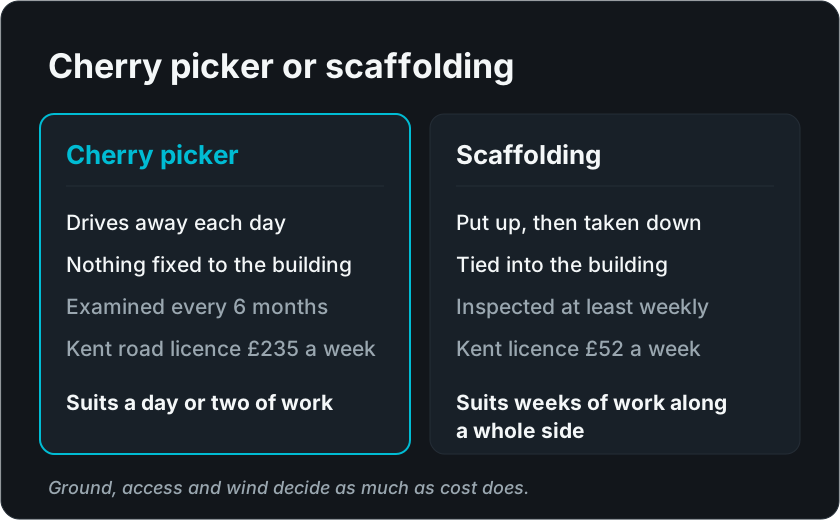
For a short job, a cherry picker is usually the better choice. If the work takes a day or two and sits at one or a few points on a building, such as a gutter, a sign, a light or a camera, a cherry picker arrives, does the work and leaves, with nothing to put up, tie into the wall, inspect every week or take down again. Scaffolding is the better choice when the work runs for weeks, covers a whole side of a building, needs several trades working at once or involves heavy materials, or when a machine cannot get close enough to the work.
The law points the same way, because it asks whoever plans work at height to weigh how long the equipment will be used and the risk of putting it up and taking it down. At Bespoke AVS we hire out our own cherry picker, a 12.5m Versalift on a Ford Transit, across Kent, the South East and London, and we use the same machine on our own CCTV and security installs. This guide compares a cherry picker and scaffolding on time, paperwork, cost and security, sets out the jobs where scaffolding is the right answer, and covers when a tower scaffold beats both.
What the law asks you to weigh
The Work at Height Regulations 2005 set out how equipment for work at height should be chosen. Collective protection, such as guardrails that protect everyone on a platform, comes before personal protection such as a harness. The regulations then list what has to be taken into account, and two items on that list decide most short jobs. One is the duration and frequency of use. The other is any additional risk posed by the use, installation or removal of the equipment.
That second point matters more than it sounds. Putting up a scaffold is work at height in its own right, done by a scaffolding gang, and so is taking it down. On a job that lasts several weeks, that extra risk is spread across weeks of use. On a job that lasts an afternoon it is not, which is the strongest reason a cherry picker suits short work.
Why a cherry picker usually wins on a short job
A van-mounted cherry picker drives to the job like any other van, sets up on its stabiliser legs, does the work and drives away. Nothing is fixed to the building, and nothing is left behind overnight. The boom reaches up and over a porch, a conservatory or a bay window that a scaffold would have to be built around, and when one point is finished the van moves along to the next.
There is less to keep on top of while the work goes on, too. The HSE's guidance on scaffolds says a scaffold has to be inspected before first use, then at intervals of no more than seven days, and again after anything likely to affect its safety, such as high winds. A cherry picker has to be thoroughly examined at least every six months, which is the owner's job rather than yours when you hire one.
The weather is the main caveat. The HSE says high winds can tilt a platform and make it unstable, and it expects a maximum safe wind speed to be set for operation, so a gusty day can move a job. On a short job that usually means a different day rather than a different method.
When scaffolding is the better choice
Scaffolding is the right answer when the job is long or covers the whole building. Re-roofing, rendering, a full repaint or replacing windows on the upper floors all need a working platform along the whole side of a building for weeks, often with several trades on it at once. A cherry picker basket is built to carry people and their tools up to a maximum load set by the manufacturer, not stacks of tiles or blocks, so jobs that need heavy materials landed at roof level belong on a scaffold.
It also wins where a machine cannot get close enough. A van-mounted platform needs somewhere to stand near the work, and the HSE warns that trenches, manholes and loose backfill can all tip one over. The back of a terraced house with no vehicle access, a soft garden or a steep slope are the cases where a van-mounted platform cannot help, and scaffolding or a different kind of machine is needed. If you are not sure whether a machine will reach, it is worth knowing what a cherry picker is and how its reach is measured before you rule one in or out.
Licences, paperwork and cost
Both need a licence when they stand on a public road or pavement. Scaffolding on or over a highway needs one under section 169 of the Highways Act 1980, and in Kent the county council's scaffolding terms ask for the application five working days before it starts. A scaffold people walk under has to leave a walkway at least 1.2 metres wide with nothing lower than 2.5 metres overhead, and one in or close to the carriageway has to be lit at night.
A cherry picker on or over the road needs its own licence, with the same five working days' notice, and the full rules are covered in whether you need a licence to use a cherry picker on the road. Kent County Council's fees for 2026–27 show the difference plainly. Scaffolding on the highway costs £52 per seven days and a cherry picker £235 per seven days. A week of cherry picker licence costs more than a week of scaffold licence, but a short job only needs one week of it, while a scaffold is licensed for as long as it stands on the highway.
Compare the hire itself the same way, on the whole job rather than a day rate. A scaffold is priced on putting it up, the weeks it stays up and taking it down again, plus any licence while it stands on the road. A cherry picker is priced on the platform you need, the length of hire, whether it comes with an operator and where the site is, plus any licence. If the work can be done in a day or two, ask for both prices on that basis and the right answer usually becomes obvious.
Operated hire also takes one cost off the list. Our operator is IPAF-trained, so nobody at your end needs IPAF certification to hire a cherry picker, and there is no paperwork or operator training to organise.
The security side of scaffolding
A scaffold left up for weeks is a climbing frame to the upper floors. Hackney Council's advice is that scaffolding can leave homes less secure because it gives burglars a way up, that anyone seen on a scaffold outside working hours should be reported on 999, and that residents should tell their household insurer when scaffolding goes up outside.
A cherry picker drives away at the end of the day, so on a short job that question never arises. If you do need scaffolding for weeks, lock the upper windows it reaches and check that the rooms behind them are covered by your alarm, because a system set up to watch the ground floor can leave them out. As security system installers as well as a hire company, we can look at home security for the weeks the scaffold is up.
When a tower scaffold beats both
For some short jobs neither is the cheapest answer. A mobile tower scaffold can suit low-level work, work indoors or work round the back where no van can reach, as long as the ground is suitable. The HSE's guidance on tower scaffolds says a tower must stand on firm, level ground, be put up by trained and competent people following the manufacturer's instructions, and never be used in strong winds. Used within those limits, a tower can do a short, low job without a scaffold or a machine.
How we handle short jobs at height
Our cherry picker hire is mainly operated hire. We turn up with the van and an IPAF-trained operator, the work gets done, and operated hire is fully insured. The same machine goes out on our own commercial CCTV installs. Fixing and cabling a camera high on a building is a clear example of a short job, and scaffolding it would be out of all proportion to the work. We work across the county for cherry picker hire in Kent from our base in Aylesford, covering Maidstone, as well as the wider South East and London.
We are Kent County Council Trading Standards Checked. You can read what customers say on our reviews page, find out more about us, or find us on Facebook.
Choosing between a cherry picker and scaffolding
For a short job at a few points on a building, a cherry picker is usually better than scaffolding. It needs nothing fixed to the building, no weekly inspections and nothing left standing overnight, and the law's own test of how long the equipment is used and the risk of putting it up points the same way. Scaffolding is the right choice for long jobs, whole elevations, several trades, heavy materials and places a machine cannot reach, and a tower scaffold can beat both on low, short work.
If you are weighing the two for a job of your own, we are glad to tell you honestly which suits it, including when that is not us. You can get in touch with Bespoke AVS with the job and the address, anywhere in Kent, the South East and London.
Keep reading
Related guides
Cherry Picker Hire
Do You Need a Licence to Use a Cherry Picker on the Road?
Usually, yes. If a cherry picker is going to stand on a public road or pavement, or its platform is going to work out over one, you need a licence from the highway authority before it goes up. Across most of Kent that authority is Kent County Council, which wants the application at least five working days ahead and charges £235 for up to seven days in 2026–27. A cherry picker working entirely on private land, with the platform kept over that land, does not normally need one.
Read guideCherry Picker Hire
What is a Cherry Picker?
A Cherry Picker is a type of access platform designed to safely lift people and equipment to height. These machines are commonly used for building maintenance, electrical work, signage installation, roofing, tree work, and many other jobs where ladders are not practical or safe.
Read guideCherry Picker Hire
Cherry Picker Hire South East England
If you have work that sits out of safe ladder reach, cherry picker hire across South East England gives you a powered access platform, and where you want it an IPAF-trained operator, to reach it safely without the cost and disruption of scaffolding. At Bespoke AVS, trading as Bespoke Access Hire, we supply van-mounted cherry pickers across Kent, the South East and London for roofing, guttering, exterior maintenance, signage, lighting, tree work and high-level inspections. For the majority of jobs, a machine delivered to site with an operator is faster to arrange, cheaper overall and considerably safer than the alternatives.
Read guideFree estimates
Tell us about the job and we'll sort the rest
No up-selling, just simple honest advice. Domestic and commercial work across Aylesford, Maidstone, Medway, Sittingbourne, Gravesend, Canterbury, Tunbridge Wells, Sevenoaks, Dartford, Bromley.