
Do You Need a Licence to Use a Cherry Picker on the Road?
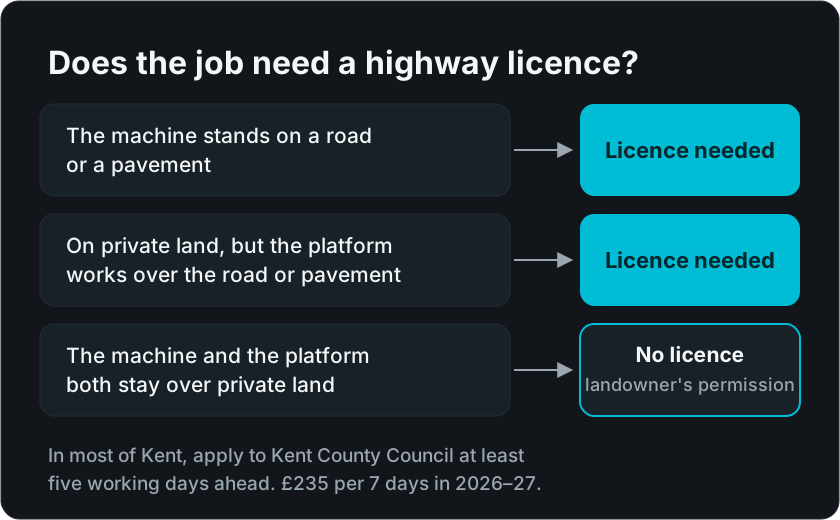
Usually, yes. If a cherry picker is going to stand on a public road or pavement, or its platform is going to work out over one, you need a licence from the highway authority before it goes up. Across most of Kent that authority is Kent County Council, which wants the application at least five working days ahead and charges £235 for up to seven days in 2026–27. A cherry picker working entirely on private land, with the platform kept over that land, does not normally need one.
Two other licences tend to get mixed up with it. Whoever drives a van-mounted cherry picker on the road needs a driving licence that covers its weight, and whoever runs the platform needs proper training, which in practice means an IPAF card. At Bespoke AVS we hire out our own van-mounted cherry picker across Kent, the South East and London, with an IPAF-trained operator or on a self-drive basis, and all three can apply to a hire. This guide covers what the highway licence is for, what Kent County Council asks for, how the rules change in Medway and London, and where the driving licence and the IPAF card fit in.
What the highway licence is for
Roads and pavements are shared by everyone, so anything that stands on them or works over them needs the highway authority's permission first. Kent County Council's terms for cranes and mobile elevating work platforms name the machines they cover, which are the ones most people call cherry pickers, boom lifts, scissor lifts and aerial work platforms. The council's fee covers a platform working over the highway as well as one standing on it, so a cherry picker parked on a private drive can still need a licence if its basket reaches out over the pavement.
The licence is there to protect the people using the road and the road itself. Kent County Council wants proof of £5 million public liability insurance, a traffic management plan, a method statement with a site-specific risk assessment and a copy of the operator's qualifications, and it checks that the site is suitable before it issues the permit. The application has to come from the main operator, the company responsible for the machine and its use on the highway, rather than from the person whose building is being worked on.
How much notice it needs and what it costs in Kent
Kent County Council needs the application at least five working days before the cherry picker goes on or over the highway, and at least three working days' notice to renew one. If the job needs the road closed, the notice period becomes three months. For most short jobs that rules a closure out, so the work has to be planned around a road that stays open.
The fee is set in the council's highways fees and charges, at £235 for each seven calendar days in 2026–27, up from £225 the year before. If the council needs a further site inspection, that costs £78. A cherry picker found on the highway without a valid permit costs the operator a £120 charge plus the £235 permit fee charged retrospectively, along with lane rental charges where they apply. If the van stands in a pay and display bay, the parking has to be paid for as well, and the council does not allow a platform in a bus stop or bus lane unless it has been contacted before the application goes in.
Working on a pavement and around people
A cherry picker on a pavement cannot simply close it. Kent County Council only allows a footway to be blocked with its express permission, and on condition that a walkway 1.5 metres wide stays open for pedestrians, cordoned off to the standard in Chapter 8 of the Traffic Signs Manual. The signing and guarding of the work has to follow the Safety at Street Works and Road Works code of practice, the same code utility companies follow when they dig up the road.
The HSE's guidance on mobile elevating work platforms adds the rules that apply on any site. The area around the platform is barriered off so that dropped tools or materials cannot hit anyone below, the machine is never worked close to overhead cables, and an arm sticking out into a traffic route is one of the hazards to plan out. On a busy street those rules decide where the van can stand as much as the licence does.
Medway, London and the rest of the South East
Kent County Council is the highway authority for most of the county, but not all of it. Medway Council runs the roads in Medway, so a job in Rochester, Chatham or Gillingham goes to Medway rather than to the county council, and the details differ. If the work needs parking bays taken out of use, for example, Medway charges £50 per bay per day for a parking bay suspension and wants the application at least ten days before the work starts.
In London the licence comes from the borough council, or from Transport for London on its red routes, and the fees vary as much as the councils do. Bromley's cherry picker licence costs £37 and covers one day at one location, where Kent's covers up to a week, and Bromley sends anyone working on its red routes, the A21 and the A232, to TfL instead. Red routes and borough-by-borough rules are part of planning any height access hire in London. Wherever the job is, the safe assumption is the one that holds in Kent. Check who owns the road, allow at least a week, and expect to show insurance and a plan for keeping people clear.
The driving licence and the IPAF card
A van-mounted cherry picker is a road vehicle, so whoever drives it needs a driving licence that covers its weight. The government's guidance on driving licence categories says a car licence, category B, covers vehicles up to 3,500kg maximum authorised mass, while vehicles between 3,500kg and 7,500kg need category C1. The platform adds weight to the van it is built on, so the figure to check is the maximum authorised mass on the vehicle's own plate, not how big the van looks.
On our operated hire none of this falls to you, because we turn up with the van and an IPAF-trained operator who runs the platform. On self-drive hire we deliver the platform to your site and your own trained operator runs it there.
The IPAF card is not a licence in law. It is often called a cherry picker licence, and its full name is the Powered Access Licence, but no statute requires anyone to hold one. What the law asks for is training. The Provision and Use of Work Equipment Regulations require employers to make sure anyone using work equipment has had adequate training, and the IPAF card is how the industry proves it, which is why a hire company asks to see one before a self-drive hire.
The full rules are covered in whether you need IPAF certification to hire a cherry picker. The short version is that on operated hire you need no card at all, because the trained operator comes with the machine.
Private land, car parks and driveways
Working from a private drive, a yard or a car park takes the highway authority out of it, as long as the platform stays over private land too. The permission you need then is the landowner's, which matters on a shared car park, a retail park or a managed estate where the person booking the work does not own the ground. The practical rules stay the same. The HSE warns that trenches, manholes and loose backfill can all tip a machine over, and that any temporary covers have to be strong enough to take the load.
The rules are the same whether the platform is out on hire or on one of our own jobs. We use the same machine on our own commercial CCTV and security system installs, so a camera on the corner of a unit or an alarm bell box on a shopfront starts with the same question as any hire, which is whether the van can stand on private ground or has to go on the road. Knowing what a cherry picker is and how far it reaches sideways helps here, because a little outreach can be the difference between working from a drive and needing the pavement.
Booking a cherry picker for a job near the road
Because a licence needs at least five working days and the layout of the street decides so much, the most useful thing you can do is give the full picture when you enquire. Tell the hire company the address, roughly how high the work is, where a van could stand, whether that spot is a road, a pavement, a pay and display bay or private ground, and the date you need. If the only place to stand is a bus stop, a bus lane or a narrow pavement, say so straight away, because those are the cases where the council has to be involved before anything else.
For cherry picker hire we send our own 12.5m Versalift on a Ford Transit, and operated hire is fully insured. We work across the whole county for cherry picker hire in Kent from our base in Aylesford, covering Maidstone, and we are Kent County Council Trading Standards Checked. You can read what customers say on our reviews page, find out more about us, or find us on Facebook.
Cherry picker licences on Kent roads
You need a licence to use a cherry picker on the road whenever it stands on a public road or pavement or its platform works over one. In most of Kent that means Kent County Council, at least five working days' notice and £235 for up to a week, with Medway Council and the London boroughs running their own versions. Separately, the driver needs a licence that covers the vehicle's weight, and the operator needs training, which an IPAF card proves. On private land, with the platform kept over that land, the highway licence normally drops away.
If you have a job that needs a cherry picker near the road and want to know what it will take, we are glad to talk it through. You can get in touch with Bespoke AVS about the job and where the van can stand, anywhere in Kent, the South East and London.
Keep reading
Related guides
Cherry Picker Hire
Do You Need IPAF Certification to Hire a Cherry Picker?
You only need IPAF certification to hire a cherry picker if you are going to operate it yourself. On operated hire, where the machine arrives with a trained operator who runs it for you, you need no qualification at all. On self-drive hire, any responsible hire company will ask to see a valid IPAF card, usually called a PAL card, for each person who will be at the controls, and it will want to see it before the machine leaves the yard.
Read guideCherry Picker Hire
What is a Cherry Picker?
A Cherry Picker is a type of access platform designed to safely lift people and equipment to height. These machines are commonly used for building maintenance, electrical work, signage installation, roofing, tree work, and many other jobs where ladders are not practical or safe.
Read guideCherry Picker Hire
Cherry Picker Hire South East England
If you have work that sits out of safe ladder reach, cherry picker hire across South East England gives you a powered access platform, and where you want it an IPAF-trained operator, to reach it safely without the cost and disruption of scaffolding. At Bespoke AVS, trading as Bespoke Access Hire, we supply van-mounted cherry pickers across Kent, the South East and London for roofing, guttering, exterior maintenance, signage, lighting, tree work and high-level inspections. For the majority of jobs, a machine delivered to site with an operator is faster to arrange, cheaper overall and considerably safer than the alternatives.
Read guideFree estimates
Tell us about the job and we'll sort the rest
No up-selling, just simple honest advice. Domestic and commercial work across Aylesford, Maidstone, Medway, Sittingbourne, Gravesend, Canterbury, Tunbridge Wells, Sevenoaks, Dartford, Bromley.