
Do You Need Planning Permission for CCTV?
In most cases you do not need planning permission for CCTV. In England, fitting security cameras to a building counts as permitted development, which means permission is granted nationally provided the cameras stay within a set of limits on size, height, number and spacing. The main exception is a listed building, where that national allowance does not apply, and if you live in a conservation area it is worth checking with the council before anything goes up.
The detail matters because the limits are tighter than most people expect, and they are easy to step outside without realising. At Bespoke AVS we install CCTV across Kent, the South East and London, and every camera position has to be checked against these rules before anything goes up. This guide sets out the national limits, the two that most often catch homes out, what changes for listed buildings and conservation areas, flats and rented homes, why planning and privacy are separate questions, and how to plan an installation that stays on the right side of both.
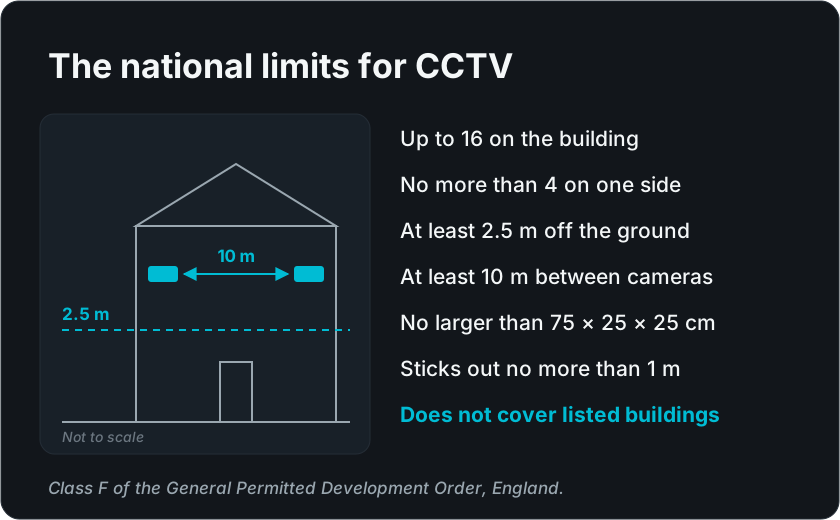
The national limits for security cameras
The allowance comes from Class F of the General Permitted Development Order, which covers installing, altering or replacing a CCTV camera on a building for security purposes. The Planning Portal, the national planning service for England, summarises the same rules for homeowners.
Within the allowance you can have up to 16 cameras on a building, with no more than four on any one side. Each camera, including its housing, must be no bigger than 75 centimetres by 25 centimetres by 25 centimetres, which every ordinary dome or bullet camera is well inside. Every part of the camera must sit at least 2.5 metres above ground level and stick out no more than a metre from the wall. Each camera must be at least 10 metres from any other camera on the building. The camera should also be positioned to keep its effect on the building's appearance to a minimum, and taken down once it is no longer needed for security.
The two limits that catch homes out
Most people would never fit 16 cameras to a house, so the number limit rarely matters. The two that do are the height and the spacing.
The 2.5 metre minimum height matters for picture quality as much as for planning. A camera mounted high looks out of reach, but the more steeply it looks down, the more it records the top of a head rather than a face, while a camera low enough to look someone in the eye is easy to knock or cover. The police ProtectUK guidance on CCTV points out that access points can give the best opportunity to identify people as they come and go, so that is where the height needs most thought. The rule sets the floor, and the right height above it is a survey decision.
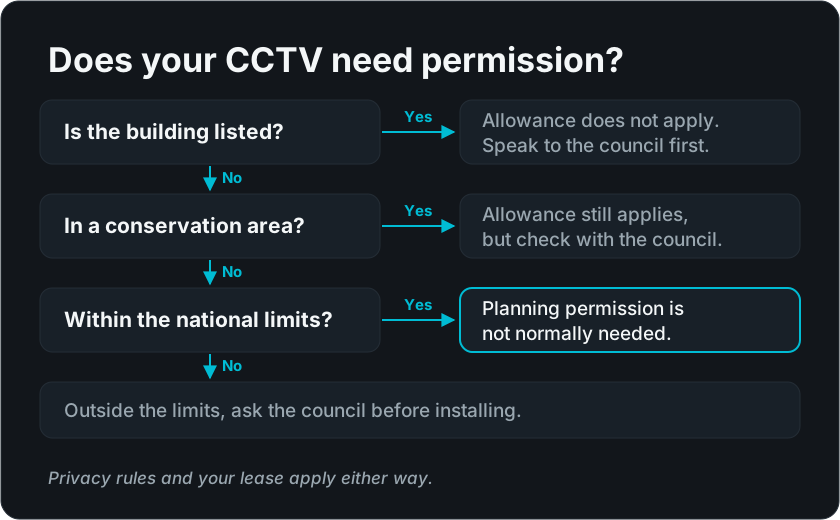
The 10 metre spacing is the one people do not expect. On a typical semi-detached or terraced house, a camera over the front door and another covering the drive are often closer together than that. Strictly, a camera fitted outside the national limits falls outside the allowance, and whether it then needs an application is a question for your local council. Whether something as small as a domestic camera counts as development at all is a matter of fact and degree, which is why the honest answer is to ask rather than assume. If you want certainty before you install, the council can confirm it, and a lawful development certificate puts the answer in writing.
Listed buildings and conservation areas
A listed building is the clear exception. The national allowance for cameras does not apply to a listed building at all. Listed building consent is a separate requirement on top of planning, and under the Planning (Listed Buildings and Conservation Areas) Act 1990 it is needed for any works that would affect the character of the building as one of special architectural or historic interest. Drilling into historic brickwork or running cable across an original frontage can easily fall into that. Speak to the council's conservation officer before anything is fixed, and expect them to care as much about the cable route and the fixings as about the camera itself.
Conservation areas are less clear-cut. The national allowance still applies, but the Planning Portal advises checking with the council, and councils can remove particular permitted development rights in parts of their area. Kent has plenty of both, in its historic town centres and its villages. If you are looking for security installers in Canterbury, where much of the city centre is historic, or CCTV installation in Tunbridge Wells, check whether the property sits in a conservation area before choosing camera positions.
On a listed or conservation area property, the condition in the national rules that each camera be sited to keep its effect on the building's appearance to a minimum does most of the work. Ipswich Borough Council's guidance on domestic CCTV applies that test whether or not permission is needed. In practice it means placing cameras where they are least visible from the street, keeping cable runs tidy and out of sight, and leaving the main frontage alone wherever another position gives the same view.
Flats, leasehold and rented homes
Planning is not the only permission that can apply. If you own a flat on a lease, the outside walls and common parts usually belong to the freeholder, and most leases need the freeholder's consent before anything is fixed to them. If you rent, you will normally need your landlord's agreement. Neither of those is a planning question, but either can stop an installation just as firmly, so check your lease or tenancy agreement before you book.
Planning is not the same as privacy
Whether you need planning permission says nothing about whether the cameras are lawful once they are recording. That is a separate question under data protection law. The ICO's guidance on home CCTV explains that if your cameras capture anything beyond your boundary, such as the street, a shared drive or a neighbour's garden, data protection law applies to you, with duties around signs, deleting footage and handing over recordings when someone asks, which form part of the wider legal requirements for CCTV in the UK.
The practical answer is the same one that keeps planning simple. Point cameras at your own property, use privacy masking where a view clips a neighbour's window, and put up a sign if the street is in shot.
Planning an installation around the rules
On a listed or conservation area property, agree the camera positions and cable runs before anything is fixed, and have any consent in place first. Carrying out works that need listed building consent without it is a criminal offence under section 9 of the 1990 Act, so drilling first and asking afterwards is the one approach to avoid. A security survey is the point to check camera positions against these rules, before anything is ordered.
Building regulations do not generally apply to the cameras themselves, but the Planning Portal points out that electrical work in your home does come under them, so any new circuit needs to be done by someone competent. We are Kent County Council Trading Standards Checked, and we install CCTV and wider home security across Kent. You can read about the team or find us on Facebook.
Getting CCTV permission right
Most CCTV in England needs no planning permission, because security cameras are permitted development as long as they stay within the national limits on number, size, height and spacing. A listed building is the exception and needs a conversation with the council first, and a conservation area is worth checking. Planning also sits apart from privacy and from any lease, so a camera can be fine on planning grounds and still need a sign, a sensible angle or a freeholder's agreement.
If you are planning cameras and want them placed properly from the start, we are glad to survey the property and tell you honestly what it needs. You can get in touch with Bespoke AVS to talk through camera positions and get a free estimate, anywhere in Kent, the South East and London.
Keep reading
Related guides
CCTV
Does CCTV Work
Does CCTV Work is a question we are asked regularly by homeowners and business owners across Kent, London, and the South East.
Read guideCCTV
Is CCTV easy to set up?
Many homeowners and business owners consider but often wonder whether the process is complicated.
Read guideFree estimates
Tell us about the job and we'll sort the rest
No up-selling, just simple honest advice. Domestic and commercial work across Aylesford, Maidstone, Medway, Sittingbourne, Gravesend, Canterbury, Tunbridge Wells, Sevenoaks, Dartford, Bromley.