
How Loud Should a Burglar Alarm Be?
A burglar alarm should be loud enough to be heard clearly from the street and by the neighbours, and the siren in an external bell box is usually rated above 100 decibels measured a metre away. There is no legal volume figure in the UK. What the rules control instead is how long the alarm sounds, and the long-established expectation is that the external siren cuts out on its own within 20 minutes.
Volume and duration both matter. An alarm that is too quiet gets ignored, and one that will not stop turns into a nuisance the council can act on. At Bespoke AVS we install and service intruder alarms across Kent, the South East and London. This guide explains how loud alarms are, why there is no legal volume limit, the 20 minute rule and what councils can do, why an alarm keeps going off, and where the bell box should go.
How loud a burglar alarm actually is
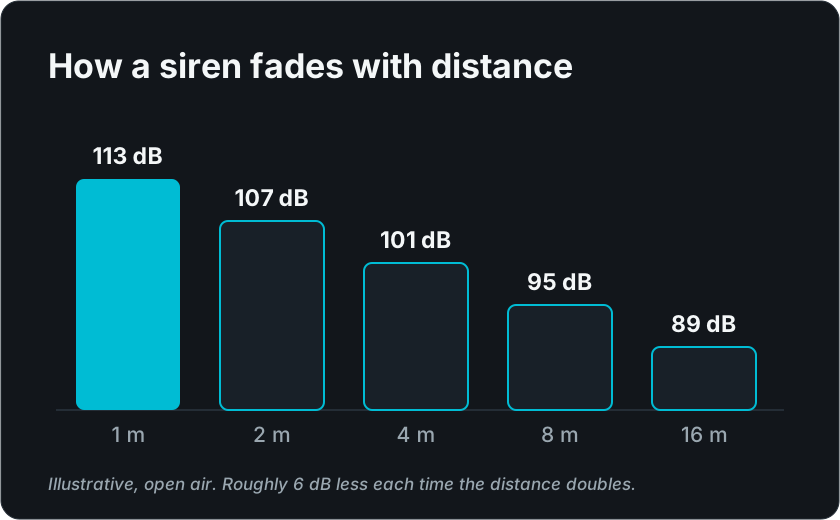
Alarm sirens are rated in decibels at a set distance, normally one metre. To take one manufacturer's own figures, the Ajax StreetSiren wireless external siren can be set anywhere from 85 to 113 decibels at one metre. That sounds enormous, and at the box it is, but sound falls away quickly with distance. In open air it drops by roughly six decibels every time the distance doubles, so a siren that is deafening on the wall is a good deal quieter by the time it reaches the house over the road.
That is why the volume is set high. The siren is not there to be loud at the box. It is there to be unmistakable at the pavement, at the neighbours' windows and inside the houses either side, which is where the people who might respond actually are. The flashing strobe on the bell box does the same job by sight, and on most systems it keeps flashing after the siren stops, so a passer-by can still see which house has gone off.
There is no legal volume limit
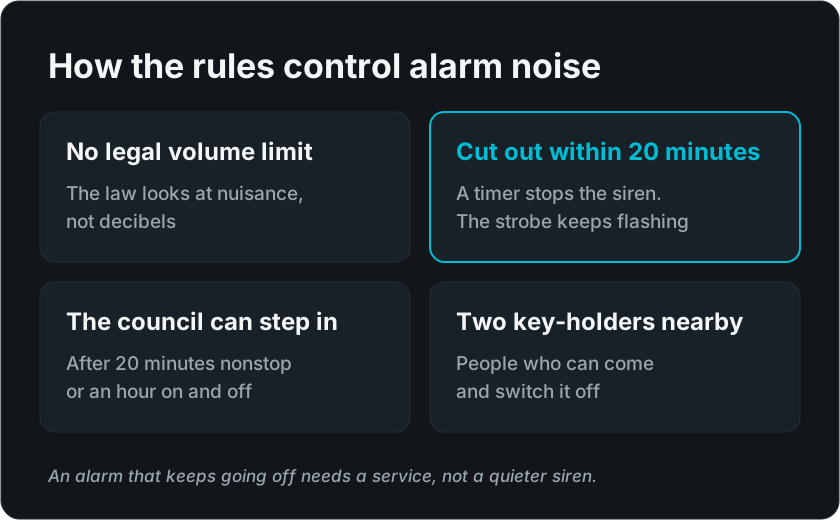
No UK law sets a maximum or minimum volume for a burglar alarm. What the law cares about is nuisance. Noise from premises that unreasonably interferes with people's use of their homes can be a statutory nuisance under section 79 of the Environmental Protection Act 1990, and the government's guidance on how councils deal with noise complaints says a council must serve an abatement notice where an alarm is causing one. An abatement notice requires whoever is responsible to stop or restrict the noise, and ignoring one is an offence.
So the honest answer to how loud is loud enough is that volume on its own is rarely the problem. A loud alarm that sounds for a few minutes when something genuinely happens is doing its job. A moderate one that goes off every week, or rings for an hour with nobody coming to switch it off, is the one that ends up with the council.
The 20 minute rule
Council guidance has long been that an external sounder should cut out automatically within 20 minutes of the alarm going off, and the law backs that up. Under section 77 of the Clean Neighbourhoods and Environment Act 2005, an authorised council officer in England or Wales can enter premises to silence an alarm that has been sounding continuously for more than 20 minutes, or on and off for more than an hour, where it is likely to give people nearby reasonable cause for annoyance. They cannot force their way in under that section, but a council can apply for a warrant to do so and recover its costs from the owner.
External sounders should be fitted with an automatic cut-out, so on a properly installed system the siren stops on its own inside that window while the strobe carries on. Medway Council's advice on intruder alarms asks for exactly that, along with regular servicing and, when you take over an existing alarm, a service to make sure it is working correctly. That first check is what an alarm takeover is for, and a siren that never stops is a fault to put right rather than something to live with. Councils can also make an area an alarm notification area, where owners must give the council the details of a nominated key-holder who can come and switch the alarm off. Even outside one, the same council advice asks householders to tell the council about the alarm and give the names of two key-holders.
Why an alarm keeps going off
An alarm that keeps going off needs its fault found, not a quieter siren. A siren that sounds with no apparent cause, or a fault or battery warning on the keypad, means the system needs looking at before its next service, and the same council advice points out that a fault in the system can set an alarm off and cause a noise problem for the neighbours, especially when it happens often. An alarm that cries wolf gets ignored by exactly the people it is meant to alert, so either is worth a call rather than a wait.
The standby battery keeps the alarm working through a power cut, and it ages whether or not the alarm is ever used. Yuasa rates its NP7-12, a 12 volt standby battery sold for fire and security systems, at a design life of up to five years at 20°C, or three to five years under the Eurobat classification, and how long alarm system batteries last in practice depends on how hard the system works and the conditions it sits in. On a system nobody has maintained, check for a tired battery, a detector blocked by furniture that has been moved, and user codes still set up for people who no longer live or work there. Those call for a proper alarm service rather than a replacement.
Where the bell box should go
The bell box is the part of the alarm that works from the street, so it belongs high and in plain sight, where it deters before anything happens and nobody can stand on a wheelie bin to silence it. The police ProtectUK advice on security at home recommends active bell boxes, with flashing lights and sounders, at both the front and the back of the property, because intruders do not want to be seen or heard. The same advice asks for side and rear gates that lock, stand at least 1.8 metres high and sit as close to the front of the building as possible. On semis and terraces the side and rear are the least overlooked parts of the property, so detection there deserves as much thought as the front door. On a tall townhouse or a commercial building, we can fit the box from one of our own access platforms, so it goes as high as it should rather than as high as a ladder reaches.
The internal sounder matters too. It is the one the intruder is standing next to, and its job is to make staying inside unpleasant while telling anyone at home that something is wrong. If you want somebody to act on the alarm when nobody is in, a siren alone relies on the neighbours, and a monitored alarm system passes the signal to people whose job is to respond.
We are Kent County Council Trading Standards Checked, and we fit and maintain alarms for homes across Kent as well as businesses. You can read about the team or find us on Facebook.
Getting a burglar alarm's volume and timing right
A burglar alarm should be loud enough to carry clearly to the street and the neighbours, and external sirens are usually rated above 100 decibels at the box for exactly that reason. The rules in the UK are about duration and nuisance rather than volume, so the siren should cut out on its own within 20 minutes, key-holders should be able to switch it off, and an alarm that keeps going off needs servicing rather than silencing.
If your alarm is too quiet, too eager or too old to trust, we are glad to look at it and tell you honestly what it needs. You can get in touch with Bespoke AVS to have your alarm looked at, or for a free estimate on a new one, anywhere in Kent, the South East and London.
Keep reading
Related guides
Security Systems
Burglar Alarm Systems Kent
Burglar Alarm Systems Kent are a key part of protecting homes and businesses across the county.
Read guideSecurity Systems
Are Smart Alarm Systems Worth It?
A smart alarm is worth it for most people who want to know when it goes off while they are away, and to set it from their phone.
Read guideSecurity Systems
What Types of Alarm Systems Are Available?
Types of Alarm Systems vary depending on the level of protection required, the type of property, and how the system is intended to be used.
Read guideFree estimates
Tell us about the job and we'll sort the rest
No up-selling, just simple honest advice. Domestic and commercial work across Aylesford, Maidstone, Medway, Sittingbourne, Gravesend, Canterbury, Tunbridge Wells, Sevenoaks, Dartford, Bromley.