
How Long Do Alarm System Batteries Last?
By Benjamin Williams
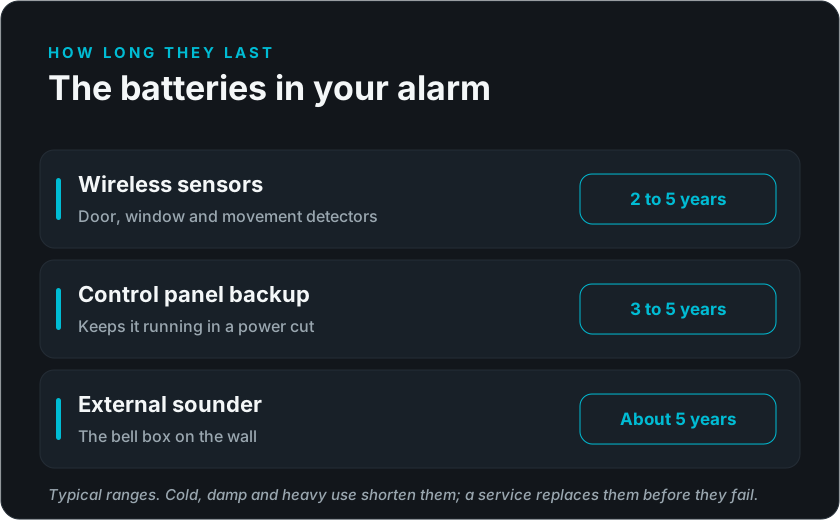
Most alarm system batteries last between two and five years, depending on the part. The small batteries in wireless door, window and movement sensors usually go two to five years, the backup battery inside the control panel typically lasts three to five years, and the battery in an external sounder is often good for around five. None of them last forever, which is why a decent system keeps an eye on its own batteries and warns you long before one actually dies. So the short answer is a few years per battery, and the important part is never being caught out by a flat one.
The reason there is a range rather than a single figure is that battery life depends on the type of battery, how often a sensor is triggered, and where in the building it lives. At Bespoke AVS we install and maintain alarm systems across Kent, the South East and London, and battery faults are one of the most common things we put right on a visit. This guide covers how long each battery typically lasts, how you will know when one is low, what makes them last longer or run down faster, and what to do when the time comes.
How long each battery lasts
An alarm is not powered by one battery but by several, and they do not all age at the same rate. Wireless sensors each carry their own small cell, and these typically last two to five years. The control panel runs off the mains but holds a backup battery so it keeps working in a power cut, and that backup usually lasts three to five years. The external sounder, the box on the wall, has its own battery so it still sounds if the wires are cut, and that is often good for about five years. Alarm standards even set how long a backup must keep a system running in a power cut, which you can read about via British Standards.
Wired systems have fewer batteries to think about, mainly the panel backup, because the sensors draw their power down the cable rather than each carrying a cell of their own.
How you will know a battery is low
You should not have to guess. A modern alarm supervises its own batteries and flags a low one on the keypad or in the app, usually weeks before it actually fails, so a battery becomes something you replace on a warning rather than discover after a failure. An older or bells-only system may just show a fault light or give an occasional chirp, which is easy to tune out, so it is worth knowing what your panel is trying to tell you. This is also one of the things a routine service checks, so if you would rather not track it yourself, it helps to know how often an alarm should be serviced.
What makes batteries last longer, or run down faster
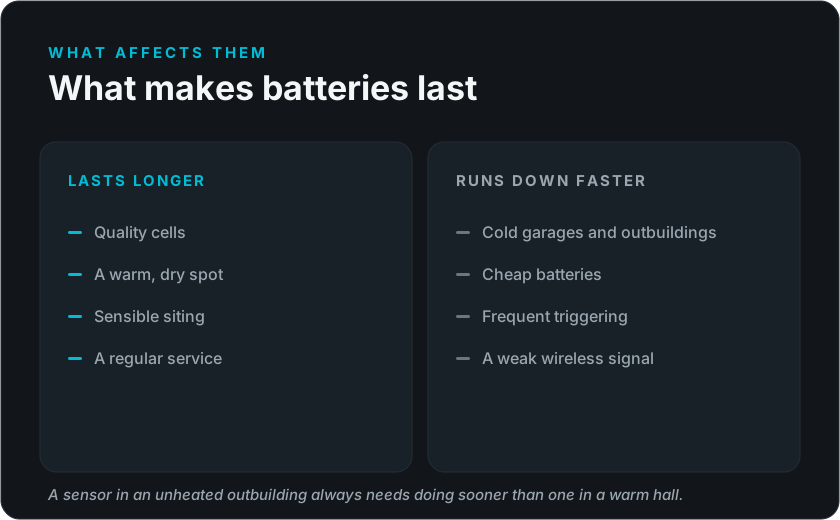
Not every battery reaches the top of its range, and where it sits makes the difference. Cold and damp are the main enemies, which is why a sensor in an unheated garage or outbuilding tends to need doing sooner than one in a warm hallway. Frequent triggering matters too, as a detector covering a busy hallway works harder than one in a spare room, and a weak signal makes a wireless sensor transmit harder to reach the panel. Quality cells, sensible siting and a system set up so sensors are not firing needlessly all pull the other way.
In our experience, replacing all of a system's sensor batteries together at a service works better than waiting for each one to fail on its own because it turns a string of small annoyances and callouts into a single planned job, and it stops you living with a low-battery warning you have quietly learned to ignore.
Wireless or wired, and what it means for batteries
It is worth knowing that this is largely a wireless question. In a wireless system every sensor carries its own battery, whereas a wired system powers most of its sensors down the cable and really only relies on the panel backup. Neither is a reason to choose one over the other on its own, and the wider trade-offs between wireless intruder alarms and wired systems are worth knowing, but it does explain why a wireless system has more batteries to keep an eye on.
What to do when a battery needs changing
When a battery does need doing it is usually a quick job, but there are a couple of things worth knowing. Sensor batteries are often a specific type rather than an AA from the drawer, and opening a sensor to change one can set off a tamper alarm if the system is not put into the right mode first. On a monitored system, replacing a battery without telling the monitoring centre can generate a false alarm. For a one-off it is fine to do yourself with the manual to hand, but if you would rather not, we handle it as part of a service. We are Kent County Council Trading Standards Checked, and because we also fit and maintain the security systems we service, we carry the batteries that actually fit them. You can read more about the team on our about us page or find us on Facebook.
Bringing it together
Most alarm batteries last a few years, two to five for the sensors, three to five for the panel backup, and about five for the sounder, and a well-set-up system will warn you before any of them fails. The batteries in an unheated outbuilding will go sooner, quality cells and a proper service will make them last, and changing them as a planned job beats being caught out by a flat one. Keep an eye on the warnings and a low battery never becomes a gap in your cover.
If your alarm is showing a low-battery or fault warning, or you simply want it checked over, we are glad to help. You can get in touch with Bespoke AVS for advice or to arrange a service across Kent, the South East and London.
Keep reading
Related guides
Security Systems
Are Smart Alarm Systems Worth It?
Smart Alarm Systems are becoming increasingly common across homes and businesses in the UK. With mobile apps, instant alerts, and remote control features, they offer far more flexibility than traditional alarm systems. However, many people still ask whether they are genuinely worth the investment or just another upgrade that adds cost without real benefit.
Read guideSecurity Systems
What Types of Alarm Systems Are Available?
Types of Alarm Systems vary depending on the level of protection required, the type of property, and how the system is intended to be used. Many homeowners and businesses assume all alarm systems work in the same way, but in reality, there are several different options, each suited to specific situations.
Read guideSecurity Systems
What Is a Grade 2 Alarm System?
A Grade 2 alarm system is an intruder alarm built to the second of four recognised security grades, and it is the level that suits most ordinary homes. The grade describes how much resistance the system is designed to have against a burglar, and Grade 2 is set for properties at low to medium risk, which covers the majority of houses and flats. In plain terms, if you are a normal household wanting a proper alarm, Grade 2 is almost certainly the one you are looking at.
Read guideFree estimates
Tell us about the job and we'll sort the rest
No up-selling, just simple honest advice. Domestic and commercial work across Aylesford, Maidstone, Medway, Sittingbourne, Gravesend, Canterbury, Tunbridge Wells, Sevenoaks, Dartford, Bromley.