
Are Pet-Friendly Alarm Systems Effective?
Yes, pet-friendly alarm systems are effective, and for most households with a cat or a dog they are the sensible way to have an alarm you actually use. They rely on pet-tolerant motion sensors that ignore movement low down, where a pet lives, while still detecting a person moving through a room. The result is an alarm you can set with the pets at home without it going off every time the dog crosses the hall. They are not magic, though, and how well they work depends on the pet, the sensor and where it is placed.
The reason they matter is that the most common reason people stop using an alarm is false activations, and pets are the usual cause. At Bespoke AVS we fit pet-friendly systems across Kent, the South East and London, and we set them up around the animals in the house rather than treating them as an afterthought. This guide explains how a pet-tolerant sensor works, how effective it really is, where it struggles, and how to get the best from one.
How a pet-friendly sensor works
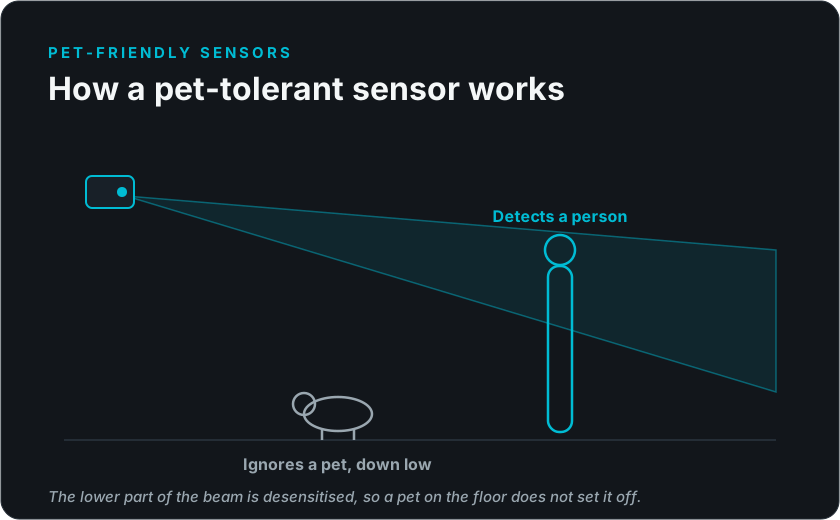
A standard motion sensor watches a room for the body heat of anything that moves through it, which is why an ordinary one will happily trigger on a dog. A pet-tolerant sensor is designed so the lower part of its detection pattern, down near the floor where a pet spends its time, is desensitised, while the upper part still picks up a standing person. Mounting height and angle are part of the design, so it is set up to look across the room at person height rather than sweep the floor. Some tricky situations use a dual-technology sensor that has to see both heat and movement before it triggers, which cuts false alarms further. A pet-tolerant sensor is still part of a system built to the same British Standards grades as any other.
How effective they really are
For most homes with a cat or a small to medium dog, a properly specified pet-tolerant system is very effective, and the false alarms that drive people mad simply stop. The key phrase is properly specified, because effectiveness comes from the placement as much as the sensor. In our experience, a pet-tolerant sensor placed and angled correctly works better than switching off the downstairs zone when you go out because it keeps the protection on where the pet actually lives, rather than leaving the whole ground floor unmonitored, which is what a lot of pet owners end up doing with an ordinary alarm.
Where they struggle
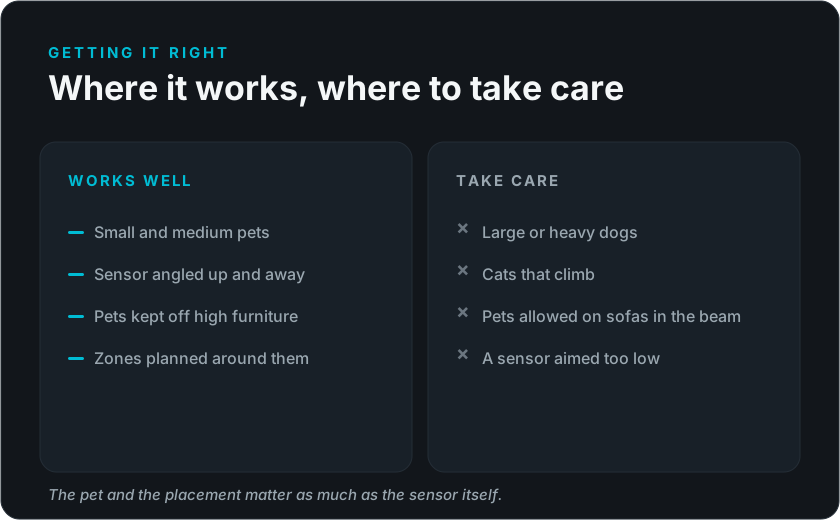
They are not a cure-all. A large or heavy dog has a body mass and heat signature close to a person's, which makes it harder for the sensor to tell them apart. Cats are the other challenge, because they climb, and a cat that gets up onto the back of a sofa or a worktop can put itself right into the part of the beam meant for people. Pets that are allowed on furniture, and sensors that have been aimed too low, are the two things we most often find behind a pet-friendly system that still cries wolf.
Getting the best from one
The answer to almost all of this is the survey. Sensors go where they look across the room rather than down at the floor, and away from the stairs, sofa backs and worktops a pet uses to get up high. Where an animal is large or a determined climber, a dual-technology sensor or a change of sensor type usually solves it, and zoning lets you leave a pet-free part of the house fully armed while the rest is pet-tolerant. It is one of the things worth raising when you think about what to look for in an alarm system, and it feeds directly into the best alarm system for a home if you share it with an animal.
Our take for pet owners
Pet-friendly alarms are effective and, for a household with a normal cat or dog, they are the right choice, because an alarm you can actually set with the pets home is worth far more than a better system you have stopped using. The honest caveat is that a big dog or a serial climber needs the right sensor in the right place rather than a box off a shelf, and that is what a survey is for. We are Kent County Council Trading Standards Checked, and we fit alarm systems around the household rather than a fixed package. You can read more about the team on our about us page or find us on Facebook.
Bringing it together
So are pet-friendly alarm systems effective? For most homes, yes, and they solve the single biggest reason people give up on an alarm. The technology ignores a pet down low while still catching a person, and where a pet is large or a climber the fix is the right sensor and sensible placement rather than giving up on protection. Get the survey right and you keep both the alarm and the cat.
If you have pets and want an alarm you can live with, we are glad to take a look and set one up around them. You can get in touch with Bespoke AVS for advice or a free estimate across Kent, the South East and London.
Keep reading
Related guides
Security Systems
How Often Should Alarm Systems Be Serviced?
Most alarm systems should be serviced at least once a year. If your system is monitored and connected to an alarm receiving centre with police response, the usual requirement is two visits a year, one of which can often be carried out remotely on systems that support it. A bells-only alarm, the kind that simply sounds a siren without any outside monitoring, generally needs one professional maintenance visit annually. That is the short answer, and for most homes and small businesses across Kent, an annual alarm systems service is the sensible baseline that keeps the system reliable and your cover intact.
Read guideSecurity Systems
Alarm Installation Surrey
Alarm Installation Surrey is one of the most effective ways to improve security for homes and businesses across the area. Surrey includes a wide range of properties, from large detached homes and gated developments to retail units, offices, and apartment blocks. Because of this, security systems need to be designed around the property itself rather than installed using a generic approach.
Read guideSecurity Systems
What Is the Best Alarm System for a Home?
The Best Alarm System for a Home depends on the property layout, the level of security required, and how the homeowner wants to use the system day to day. In our experience, there is no single alarm system that works perfectly for every home. A detached property in rural Kent requires a different setup compared to a flat in London or a semi detached home in Maidstone.
Read guideFree estimates
Tell us about the job and we'll sort the rest
No up-selling, just simple honest advice. Domestic and commercial work across Aylesford, Maidstone, Medway, Sittingbourne, Gravesend, Canterbury, Tunbridge Wells, Sevenoaks, Dartford, Bromley.